
Mobile Brain-Body Imaging (MoBI) & Sports Neuroscience
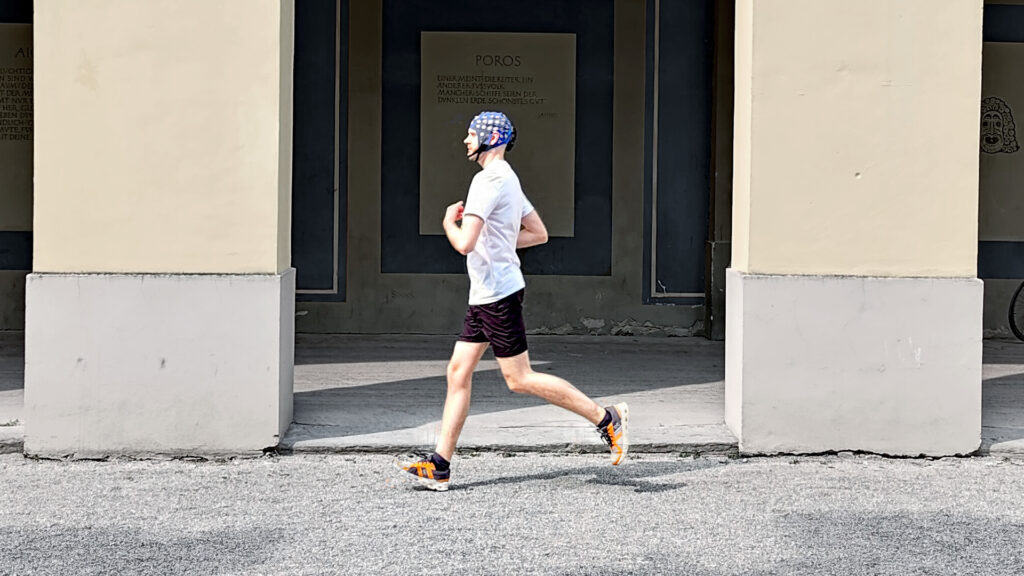
Mobile EEG and Mobile Brain–Body Imaging (MoBI) represent a paradigm shift in neuroscience, allowing for the measurement of (neuro)physiological activity during physical exertion and real-world movement. This approach enables researchers to capture neural signals outside the laboratory to study how the brain adapts under high coordination demands or how elite athletes maintain focus under pressure.
Mentalab’s ambulatory EEG technology is built for ecological validity. Artefact Subspace Reconstruction (ASR), available through Mentalab Explore Signals, allows for the removal of non-brain signals, making EEG viable for high-intensity movement. By combining high-precision neural data with integrated motion sensors, our system provides the most robust platform for tracking cognitive and physiological states in naturalistic environments and sports arenas.
Our Solution – Mentalab Explore Pro
- Designed for Motion: Lightweight, wearable EEG design that minimizes movement artifacts and supports naturalistic sports studies.
- Unmatched Portability: 8GB internal Flash memory for offline EEG data acquisition when outside of Bluetooth range.
- Superior Data Cleaning: Real-time Artefact Subspace Reconstruction (ASR) via Explore Signals to ensure clean data during vigorous activity.
- Full-Body Integration: Wireless, high-resolution EEG (up to 32 channels) that integrates with kinematic sensors and IMUs via LSL.
- Millisecond Precision: High-precision wireless event marking (< 1 ms) for accurate ERP analysis even during active movement.
- Multi-Subject Tracking: Hypersync for team-based studies, enabling the analysis of inter-person dynamics in team sports.

Choose our Mentalab Explore Pro mobile EEG system combined with our wireless synchronisation solution, Mentalab Hypersync.

Resources
Publications
A Comparison of Approaches for Motion Artifact Removal from Wireless Mobile EEG During Overground Running
Ledwidge, P. S., McPherson, C. N., Faulkenberg, L., Morgan, A., & Baylis, G. C. (2025). A Comparison of Approaches for Motion Artifact Removal from Wireless Mobile EEG During Overground Running. Sensors, 25(15), 4810.
A Comparative Analysis Between National-Level and Young Professional Road Cyclists: A Psychophysiological Approach
Pirlot, T., Baron, B., Scholler, V., Grappe, F., Pageaux, B., & Groslambert, A. (2025). A Comparative Analysis Between National-Level and Young Professional Road Cyclists: A Psychophysiological Approach. International Journal of Sports Physiology and Performance, 20(11), 1471-1480.
Neural evidence for attentional resource allocation to postural control using brain-body imaging
Fakorede, S., Alkhameys, F., Liao, K., Martin, L., & Devos, H. (2025). Neural evidence for attentional resource allocation to postural control using brain-body imaging. Behavioural Brain Research, 494, 115716.
Hemispheric synchronization patterns linked with shooting performance in archers
Dirik, H. B., Ertan, H. (2024). Hemispheric synchronization patterns linked with shooting performance in archers. Behavioural Brain Research, 460, 114813.
Smart Armband with Graphene Textile Electrodes for EMG-based Muscle Fatigue Monitoring
Ozturk, O., Golparvar, A., & Yapici, M. K. (2021). Smart Armband with Graphene Textile Electrodes for EMG-based Muscle Fatigue Monitoring. In 2021 IEEE Sensors.
The Effect of Sensory Reweighting on Postural Control and Cortical Activity in Parkinson’s Disease: A Pilot Study
Sadeghi, M., Bristow, T., Fakorede, S., Liao, K., Palmer, J. A., Lyons, K. E., … & Devos, H. (2024). The Effect of Sensory Reweighting on Postural Control and Cortical Activity in Parkinson’s Disease: A Pilot Study. Archives of Rehabilitation Research and Clinical Translation, 100368.
Individual Alpha Peak Frequency Decreases Following Archery Shots
Dirik, H. B., di Fronso, S., Ertan, H.. Individual Alpha Peak Frequency Decreases Following Archery Shots. Preprint.