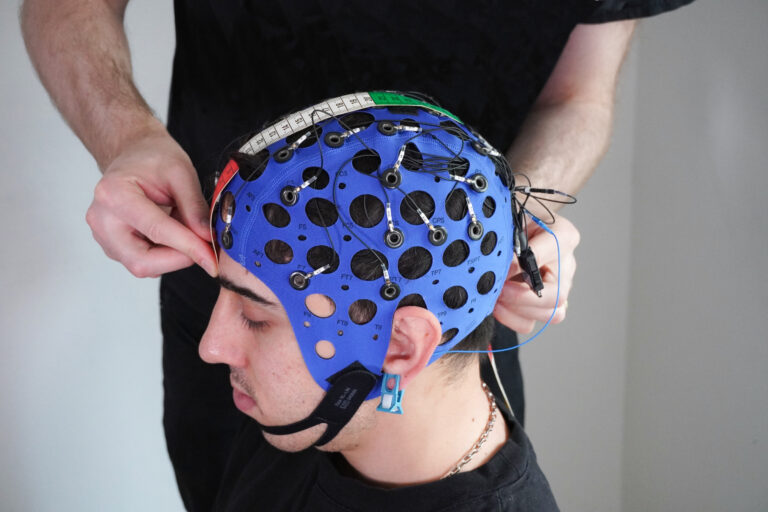
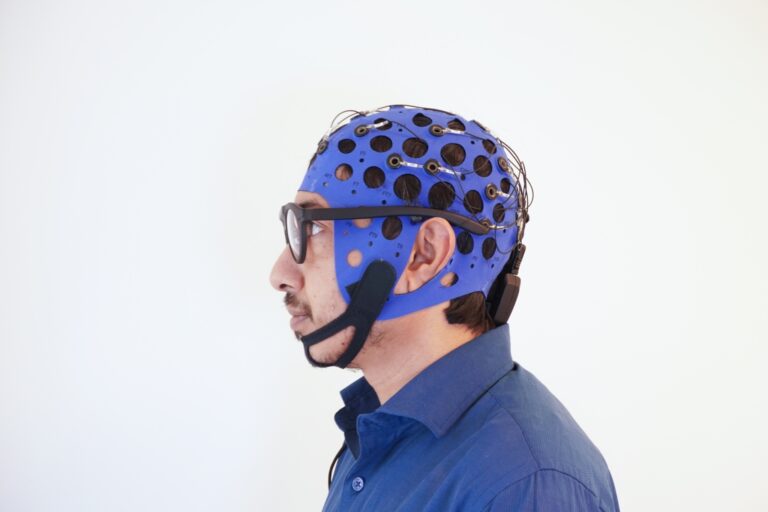
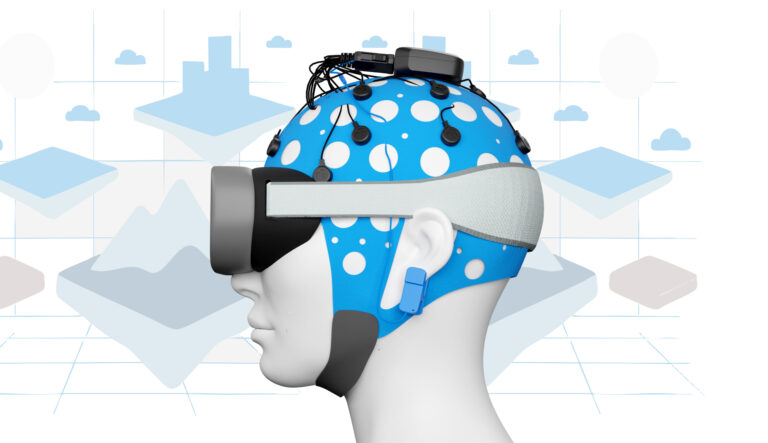
EEG is no longer limited to experiments in which participants sit as still as possible in front of a computer. Researchers can now record brain activity while people walk, interact with others, work, use virtual environments, and participate in sport.
However, the term “mobile EEG” does not always tell us how mobile an experiment actually is. A participant might walk on a treadmill while connected to equipment that remains in one place. Another might carry a recording computer in a backpack. In a third setup, a small head-mounted amplifier might record directly to internal memory without requiring a nearby phone or computer.[1] All three can reasonably be called mobile EEG, but they allow different levels of freedom. This lack of a clear definition led Bateson and colleagues to develop the Categorisation of Mobile EEG (CoME) framework in 2017.[1]

What did the paper set out to do?
The researchers wanted to make mobile EEG studies easier to describe and compare. At the time, EEG systems were already being compared in terms of usability, signal quality, performance, and electrode type. What appeared to be missing was a shared way to describe mobility itself.
To develop the framework, the authors examined 30 published EEG studies. Their selection included 29 studies described as mobile or ambulatory, or involving movement during recording, together with one static EEG study that served as a reference point. The studies covered many activities, including sitting, finger movements, treadmill walking, outdoor walking, cycling, stair climbing, carrying objects, and treadmill running. The equipment also varied. Some systems remained entirely off the body. Others were carried at the waist or in a backpack. Some were mounted on the head and connected wirelessly to a computer or smartphone.
Based on these differences, the authors created four measures: device mobility, participant mobility, system specification, and channel count.
The four dimensions of CoME
CoME describes a mobile EEG study using four parameters. A study can therefore be summarized in a format such as (2D, 4P, 17S, 32C).
1- Device mobility (D)
Device mobility describes where the EEG equipment is located and whether additional recording equipment is required. It is scored from 0 to 5:
- 0D: All equipment is off the body, and the participant is connected to it by cables.
- 1D: Equipment is worn at the waist or back, with additional equipment carried in a backpack.
- 2D: All equipment is carried at the waist.
- 3D: The EEG system is head-mounted but requires additional equipment in a backpack or at an off-body location.
- 4D: The system is head-mounted and requires a smartphone or tablet.
- 5D: The system is head-mounted and requires no additional recording equipment.
The highest category described what future systems might achieve. None of the studies reviewed by the authors used a 5D setup.
2- Participant mobility (P)
Participant mobility describes what the person actually does during the experiment. It is also scored from 0 to 5:
- 0P: Lying, sitting, or standing still.
- 1P: Local movement, such as pressing a button or tapping a finger.
- 2P: Constrained walking or cycling.
- 3P: Unconstrained walking or cycling.
- 4P: Activities such as climbing stairs, carrying objects while walking, or constrained running.
- 5P: Unconstrained running, vigorous physical exercise, or sport.
Keeping device and participant mobility separate is one of the framework’s most useful ideas. A wearable EEG system can still be used in a resting-state experiment, resulting in a high D score but a 0P score. In contrast, a participant may walk or run while the recording equipment remains relatively restricted.
3- System specification (S)
The system-specification score combines four technical features:
- bit resolution;
- sampling rate;
- battery life; and
- electrode type.
Each feature receives between one and five points, producing a total score from 4S to 20S.
The authors included this dimension because mobility alone does not describe an EEG system’s technical setup. A compact system may allow a great deal of movement, but researchers still need to consider whether its recording specifications are suitable for their experiment.
However, the S score should not be treated as a complete measure of signal quality. A single number cannot represent every technical and practical factor that affects EEG data.
4- Channel count (C)
The final value reports the number of EEG channels used.
The authors kept channel count separate rather than turning it into another ranked score. More channels can be useful for some types of analysis, including spatial filtering and source reconstruction. However, the right number depends on the research question and electrode placement.
A focused study using eight channels is therefore not automatically weaker than a study using 64 or more.

What did the authors find?
Across the studies reviewed, device mobility ranged from 0D to 4D, participant mobility from 0P to 4P, and system specification from 6S to 17S. No study reached the theoretical maximum of (5D, 5P, 20S).
The authors presented this maximum as a possible future combination: a completely head-mounted system requiring no additional recording equipment, used during unconstrained movement, with the highest technical score in their framework. The results also pointed to a possible challenge in the technology available at the time. Systems with higher technical specifications were not always the most mobile, while some of the more wearable systems had lower specification scores.The authors did not present this as a proven rule. Instead, they suggested that CoME could help researchers study these relationships as the field developed.
Most importantly, CoME was not intended as a product ranking. A higher score does not necessarily mean a better system or a better study. A researcher may choose to use an off-body computer for stimulus presentation and synchronization. Another may select fewer channels to reduce preparation time or improve participant comfort. The key question is whether the chosen setup is right for the study.
What still works, and what has changed?
CoME remains useful because it encourages researchers to be specific.
Where is the amplifier located? Is a phone, computer, or backpack required? What movement takes place during the experiment? Which settings, electrodes, and channel configuration are used Answering these questions makes a study easier to understand and compare with other research. However, the framework also reflects the technology and research priorities of 2017. Its specification score does not include several features that matter in current mobile EEG research, such as:
- amplifier weight;
- internal storage;
- wireless stability;
- integrated motion sensors;
- event synchronization;
- input range and impedance;
- access to raw data; and
- participant comfort.
Higher specifications are not always necessary. A sampling rate above 1 kHz may be useful for some applications but provide little practical benefit for others. Electrode choice also depends on the recording environment, preparation time, participant group, and planned analysis.
CoME is therefore best used as a framework for describing a study rather than as a current standard or a complete measure of EEG quality.
Applying CoME to Mentalab Explore Pro
CoME should be applied to a particular experimental setup rather than permanently assigned to a product.
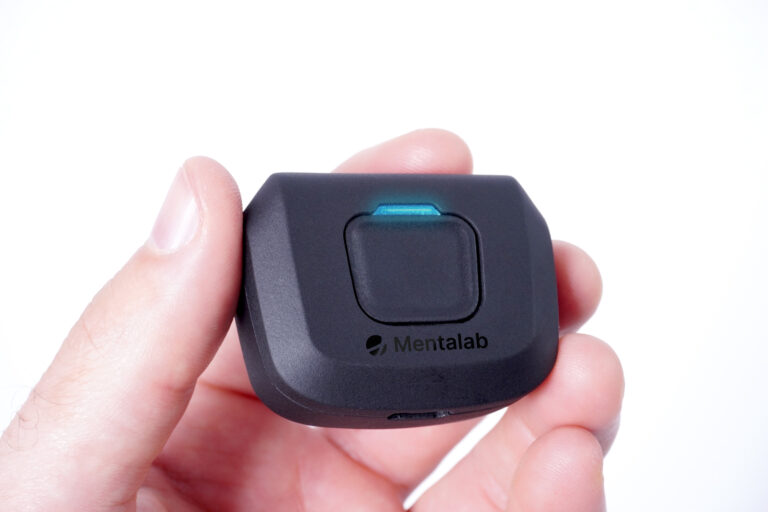
Explore Pro can record offline to its internal memory. When the amplifier is mounted on the head and records without a connected phone or computer, the setup fits the framework’s 5D device-mobility category.
When CoME was introduced in 2017, this category represented a future possibility. Today, this type of standalone, head-mounted recording is possible. However, the score changes with the workflow. If a smartphone is used for monitoring or recording, the setup is closer to 4D. If the device streams to an off-body computer, it would fit 3D, even though the amplifier remains head-mounted. These setups serve different experimental needs. They should not be seen as a simple better-to-worse ranking.
Participant mobility must also be assessed separately. Explore Pro used for a resting-state recording would still receive a 0P score. A study involving controlled running could receive 4P, while 5P would require unconstrained running, demanding physical exercise, or sport within the study itself.
The Explore Pro offers 24-bit resolution, internal memory, wireless and offline recording, integrated motion sensing, and battery life of up to ten hours, depending on the recording conditions. These features show the progress made in combining mobility with the technical capabilities needed for research. However, they do not mean that the Explore Pro achieves CoME’s complete (5D, 5P, 20S) maximum.
The P score belongs to the study, not to the device. CoME also reserves its highest S points for values such as more than 24-bit resolution and more than 24 hours of battery life.
A more accurate conclusion is: The Explore Pro can fit CoME’s highest device-mobility category when used in a standalone, head-mounted setup. Its other CoME values depend on the study design, settings, electrodes, and number of channels used.

What does this look like in published research?
A 2025 study by Ledwidge and colleagues used a 16-channel Mentalab Explore+ system while 21 participants completed a cognitive task involving controlled overground jogging and directional sidesteps.[3]
The researchers compared several methods for reducing motion artefacts and tested whether meaningful EEG components could be recovered during movement.
In CoME terms, the study shows why device and participant mobility need to remain separate.
The participants performed substantial but controlled movement. This fits the logic of the 4P category rather than the 5P category for unconstrained running or sport. The system streamed data to an off-body computer for recording and synchronization, making the study setup closer to 3D than 5D.
That setup was not a weakness. The computer served a clear purpose in the experiment.
The researchers reported that Artifact Subspace Reconstruction and iCanClean improved the recovery of dipolar brain components under the conditions they tested. In their analyses, iCanClean performed somewhat better. The expected P300 congruency effect was also identified after iCanClean processing.
These results relate to the conditions of that study. They also show that mobile EEG research is no longer only about making the hardware wearable. Researchers must also assess how movement-related artefacts affect the data and how they can be managed.

Mobility is only one part of the evidence
A separate 2023 study examined Mentalab Explore during resting-state recording.[3] The researchers compared selected EEG spectral features recorded with Mentalab Explore and a clinical-grade EEG system in 23 participants. They also tested whether the Mentalab measurements were similar across two sessions.
The authors reported agreement between the systems for the resting-state spectral measures they assessed, as well as similar Mentalab results between sessions. These findings apply to the conditions and measures used in that study. They should not be taken as validation for every EEG task or movement condition.
The resting-state and running studies therefore answer different questions. One assesses selected signal features under controlled conditions. The other examines EEG recording and artefact processing during substantial movement. Together, they show why mobile EEG should be supported by different types of evidence rather than summarized by one overall score.
Beyond the label
The lasting contribution of the CoME paper is a simple but important idea: mobility has more than one dimension.
Instead of asking only whether an EEG system is mobile, it is more useful to ask:
- How is the device set up?
- Does the recording require additional equipment?
- How does the participant move?
- Which channels and settings are used?
- What evidence supports the system in that context?
These questions help researchers choose a setup that fits their study. They also allow us to discuss progress in mobile EEG without turning different systems or research choices into a competition. In 2017, fully head-mounted recording without additional equipment was a future goal within the framework. Today, that setup is possible. The next step is not simply to maximize every score. It is to use this flexibility to design clear, reproducible studies that answer meaningful research questions.
Interested in developing a mobile EEG study? Explore Mentalab’s mobile EEG systems or contact our scientific solutions team to discuss the setup that fits your protocol.
Selected References
- Bateson, A. D., Baseler, H. A., Paulson, K. S., Ahmed, F., & Asghar, A. U. R. (2017). Categorisation of mobile EEG: A researcher’s perspective. BioMed Research International, 2017, Article 5496196. https://doi.org/10.1155/2017/5496196
- Dirik, H. B., Darendeli, A., & Ertan, H. (2023). The new wireless EEG device Mentalab Explore is a valid and reliable system for the measurement of resting state EEG spectral features. Brain Research, 1798, 148164. https://doi.org/10.1016/j.brainres.2022.148164
- Ledwidge, P. S., McPherson, C. N., Faulkenberg, L., Morgan, A., & Baylis, G. C. (2025). A comparison of approaches for motion artifact removal from wireless mobile EEG during overground running. Sensors, 25(15), 4810. https://doi.org/10.3390/s25154810